
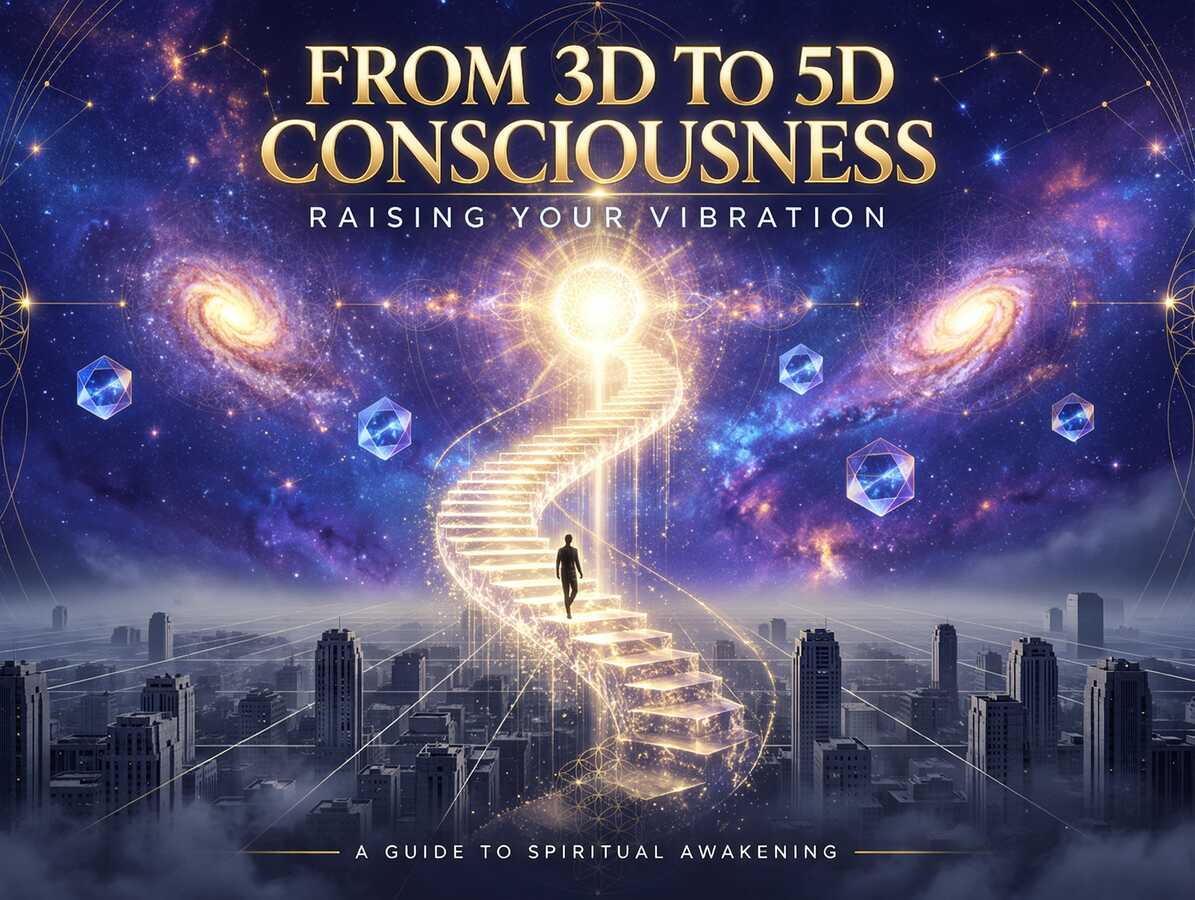
From 3D to 5D Consciousness: Raising Your Vibration
Disclosure: This post contains affiliate links. If you click through and make a purchase, We may earn a commission at no additional cost to you.
The terms 3D and 5D consciousness describe two different states of human awareness and perception, rather than physical locations. It come from spiritual and New Age teaching, and they are used loosely enough that two people can say the same words and mean different things. This article sets out what the framework claims, describes each state as everyday habits, and ends with practices and questions you can try without adopting anyone’s beliefs.
In ascension teachings, “dimension” describes a level of consciousness more than a place. Third-dimensional awareness is usually described as life focused on the physical world: separation between people, competition for limited resources, reaction to whatever happens, and identity built from roles, possessions and status. Fifth-dimensional awareness is described as the opposite orientation: a sense of unity with others, compassion, intuition, and responding from calm instead of fear.
- 3D consciousness is rooted in the physical, material world. It relies heavily on the five senses, linear time, and ego-driven survival. People operating in 3D often experience life through duality—viewing things as strictly good or bad—which can lead to fear, judgment, and a sense of separation from others.
- 5D consciousness represents a higher vibrational state of unconditional love, unity, and spiritual awareness. In 5D, individuals move beyond ego and fear, recognizing their deep interconnectedness with everyone and everything. It fosters intuition, empathy, inner peace, and living harmoniously in the present moment.
Where the 3D and 5D Consciousness Comes From, and What it Caims
The vocabulary borrows the word “dimension” from mathematics and physics and applies it to inner life. In this usage, 3D consciousness is the ordinary, everyday mode of awareness. It is tied to the physical world, to separation between people, and to the sense that life happens to you. The article on unveiling the illusion of the real-life matrix looks at that category in more detail. On the other hand, 5D consciousness is described as a wider mode of awareness, marked by a sense of connection, compassion, presence and inner stability.

The ideas draw on older spiritual traditions that describe levels or planes of awareness, and they were spread mostly through New Age books, channeled writing, workshops and, more recently, social media. There is no single authority and no agreed definition. Some teachers describe 4D as a transitional stage between the two, and others skip it. Various dates have been proposed for the “shift” into 5D, and the proposals differ from one teacher to the next.
What the framework claims, in its plainest form:
- People can operate from different states of awareness.
- Those states show up in how we treat others, money, conflict and ourselves.
- Humanity, collectively, is said to be moving toward the more connected state.
The first two claims can be checked against your own daily behavior. The third is a belief, and the rest of this article treats it as one.
What 3D Consciousness Looks Like in Everyday Life
In this framework, 3D awareness is not bad or primitive. It is the default mode most people spend most of their time in, and it has real uses: planning, protecting yourself, meeting deadlines, noticing risk.
Manifest your dream reality, supercharge your intentions, raise your frequency, and unlock the personalized spiritual tools you need to succeed on your journey.
Its typical habits look like this:
- Seeing separation. Other people are competitors, obstacles or audiences. Your interests and theirs seem to pull in opposite directions.
- Reacting automatically. A rude email or a traffic jam produces an immediate emotional response, and you act on it before you have examined it.
- Judging by outcomes. Your sense of worth rises and falls with results, status, income or approval.
- Scarcity thinking. There is only so much money, attention and opportunity, so gaining something means someone else loses it.
- Identifying with your thoughts. If a thought says “I’m a failure,” you treat it as a report of fact.
Notice that none of this requires being unkind. A thoroughly decent person can live almost entirely in these patterns, because they are the patterns most of our culture teaches and rewards.
What 5D Consciousness Looks Like in Everyday Life
The 5D description is the same life lived with a different relationship to your own reactions. Practitioners describe it through habits more than through special experiences:

- Seeing connection. Other people are understood as having needs, fears and histories like your own. Their interests are not automatically opposed to yours.
- Pausing before reacting. The emotion still arrives, but there is a gap between feeling it and acting on it.
- Valuing who you are over what you achieve. Results matter, but your basic worth is not up for renegotiation every time one goes badly.
- Abundance thinking. You treat generosity, collaboration and enough-ness as workable starting points. This does not mean ignoring a budget.
- Observing your thoughts. A thought like “I’m a failure” is noticed as a thought, examined, and often set aside.
Described this way, 5D awareness is less about floating above ordinary life and more about how steadily you handle it. Teachers who use the term often describe it as a direction of travel rather than a place you arrive and stay.
3D vs 5D Consciousness Comparision
The clearest way to see the difference is to compare how each state tends to handle the same situations.
Situation | 3D pattern | 5D pattern |
|---|---|---|
Conflict | Defend your position, look for who is at fault, win the argument | Listen for what the other person needs, state your own needs plainly, accept a resolution that is fair even if you don’t win |
Money | Fear of not having enough, comparing yourself to others, spending or hoarding to manage anxiety | Treating money as a tool, deciding spending by values, giving and receiving without keeping score |
Relationships | Valuing people for what they offer, keeping a tally of favors, needing agreement | Valuing people as they are, giving without a ledger, tolerating disagreement |
Self-talk | Harsh inner critic, treating every thought as true, rehearsing worst cases | Noticing the critic, questioning its claims, speaking to yourself as you would to a friend |
Common Misunderstandings: Bypassing, Superiority and “Good Vibes Only”
Because the language is attractive, it is easy to misuse. Three problems come up repeatedly.
Spiritual bypassing
Spiritual bypassing means using spiritual ideas to avoid difficult feelings or real problems. Telling yourself “I’m above anger” when you are angry does not resolve the anger. It hides it. In the framework’s own terms, a more connected awareness should be able to feel grief, fear and anger fully and let them pass. Skipping them is a 3D habit wearing spiritual clothes.
Decode the hidden language of the cosmos and connect with ultimate source energy through the power of sacred geometry.
Superiority
Sorting people into “3D” and “5D” and placing yourself in the second group is a way of judging others, which is exactly the separation the framework says it is moving away from. If you catch yourself thinking that someone is “low vibration” because they disagree with you, that thought is the 3D pattern in plain view.
“Good vibes only”
Insisting on positivity at all times asks people to deny what is true for them. A friend who is struggling needs someone to listen, not a reminder to think positively. Real compassion includes staying present with unpleasant things. Related to this, the idea that illness, poverty or misfortune are caused by a person’s “low vibration” is a belief with no evidence behind it, and it blames people for circumstances they did not choose.
Five Small Daily Practices
These practices are common in many contemplative traditions and are not exclusive to the 5D framework. None needs special equipment, and each can be done in a few minutes.
- Pause before responding. When something irritates you, take one slow breath before you speak or reply. The aim is a gap long enough to choose your response.
- Label your thoughts. When a harsh thought arrives, add the words “I’m having the thought that…” in front of it. Saying it this way makes it easier to see the thought as an event in your mind and not a verdict.
- Do one thing for someone without telling anyone. A small favor, a kind message or a bill paid for someone, done with no credit. This works directly against the habit of keeping score.
- Spend a few minutes in silence each day. Sit without a phone, music or a task. Notice what your mind does. Even five minutes gives you a clearer view of your usual patterns.
- Ask what the other person needs. In your next disagreement, before explaining your view, ask a question about theirs and listen to the answer without preparing your reply.
Pick one and use it for a week before adding another. Practices piled on all at once tend to be dropped all at once.
Questions to ask Yourself When you Notice you’ve Slipped Back Into 3D
You will slip, repeatedly, and the framework itself expects this. The useful move is to notice it without punishing yourself. These questions help:
- What am I feeling right now, and where do I feel it in my body?
- Am I reacting to what happened, or to a story I have told myself about it?
- Am I treating this person as an opponent? What might they be afraid of or need?
- Am I afraid of not having enough? Is that fear based on my actual situation or on a habit of worry?
- Is the voice in my head speaking to me the way I would speak to a friend?
- If I were not trying to win or be right, what would I do next?
- Have I pushed away a feeling because it seemed “unspiritual”? What happens if I let it be there?
Discover Our Featured Articles: Esoteric Wisdom: Ancient Teachings & Inner Awakening
You do not need to accept the idea of dimensions to use these questions. If you find the 3D and 5D language helpful, it gives you a shared vocabulary for noticing your own habits. If you find it unhelpful, the habits, practices and questions stand without it. In both cases the test is the same: whether you handle conflict, money, people and your own thoughts with more steadiness and honesty than before.
This topic is part of the broader Esoteric Wisdom framework, where ancient symbolic systems, consciousness studies, and hidden philosophical traditions are explored in depth.
Related Topics